




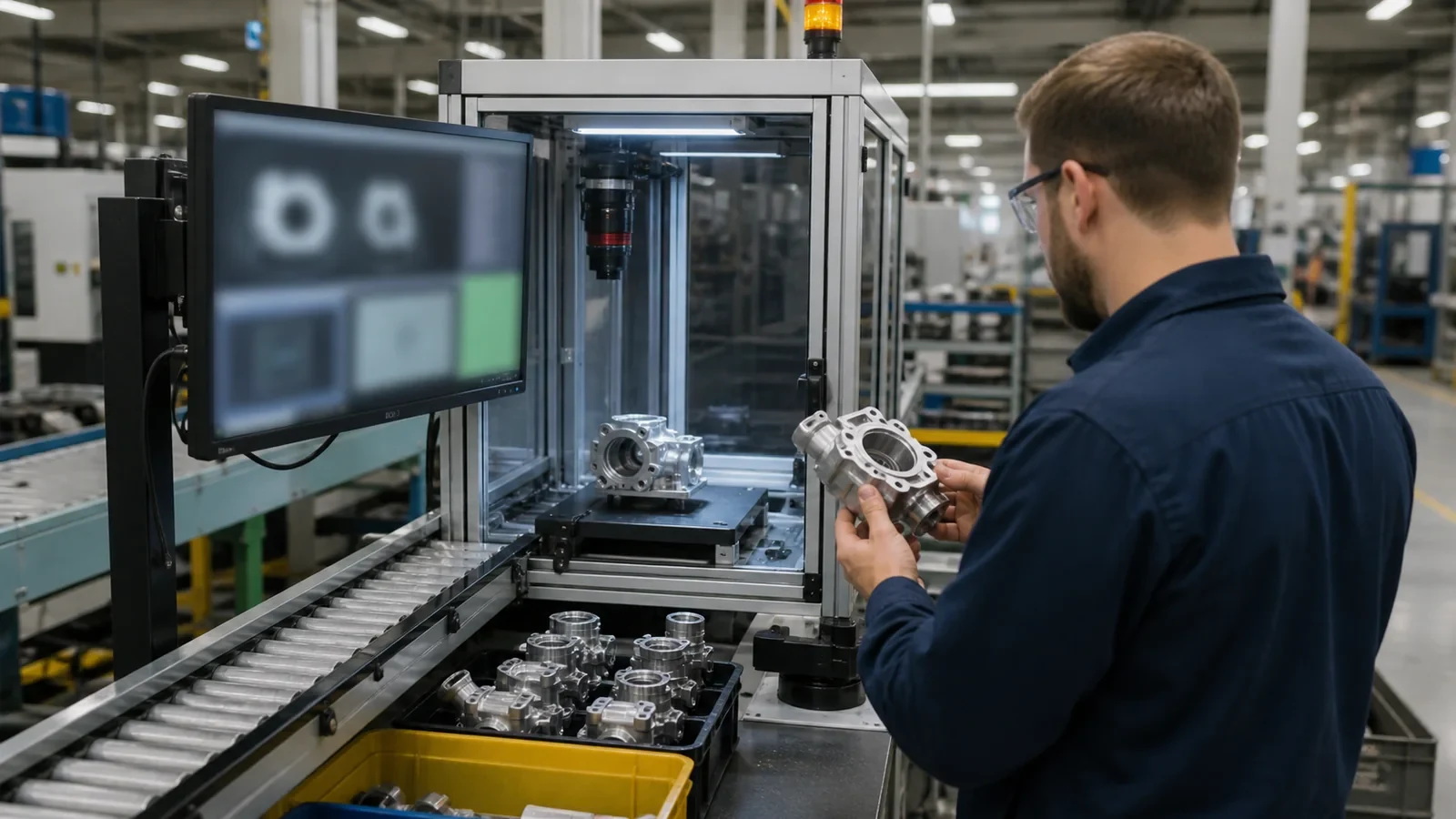
AI works in manufacturing when it detects or predicts a pattern that matters, has representative data to learn from, and triggers an operational response worth more than the system’s full lifecycle cost. If a stable rule, sensor limit or statistical process control chart solves the problem, use that simpler method first.
| Decision rule Use AI only when four conditions are true: the target outcome is measurable, the data represents real operating variation, the cost of errors is acceptable and controlled, and a named person or system can act on the output. |
AI, rules or generative AI: choose the right tool
| Approach | Best suited to | Example | Main limitation |
| Fixed rule / limit | Known relationship and stable threshold | Alarm above a pressure limit | Brittle when conditions vary |
| SPC / statistical model | Process stability and abnormal variation | Control chart for fill weight | Needs sound sampling and process discipline |
| Predictive ML | Complex patterns with labelled outcomes | Failure-risk score from sensor history | Data drift and false predictions |
| Computer vision | Visual classification, detection or measurement | Surface-defect inspection | Lighting, product and camera changes |
| Generative AI | Language, retrieval and draft assistance | Maintenance knowledge assistant | Unsupported or incorrect output |
This comparison prevents technology from dictating the problem. A generative assistant can make manuals easier to search, but it should not invent a safety procedure. A vision model may identify a suspicious unit, but the disposition rule and traceability remain part of the quality system.
Where industrial AI is most credible
| Use case | Required data | Operational action | Dangerous error |
| Visual quality | Representative images and verified defect labels | Inspect, divert or review a unit | False pass releases a defect |
| Predictive maintenance | Condition, event and maintenance history | Plan inspection or replacement | Missed failure or excessive maintenance |
| Process optimisation | Inputs, recipe, environment and quality result | Recommend a bounded set-point change | Recommendation destabilises the process |
| Demand/production planning | Orders, history, constraints and calendar | Adjust plan or inventory | Forecast drives shortage or excess stock |
| Knowledge assistant | Approved manuals, procedures and permissions | Retrieve and summarise controlled information | Plausible but unsupported instruction |
The most useful starting point is usually a narrow workflow with abundant examples and a reversible action. Advisory output is often safer during the pilot than autonomous control. The team can compare the recommendation with the operator’s decision, examine errors and prove whether the output changes performance.
What is changing in industrial AI in 2026
Industrial AI is moving from isolated model demonstrations into bounded production workflows. The change is visible in how projects are evaluated. A useful system must do more than produce a prediction: it must deliver the result to an authorized user or control function, support a defined response and record what happened next. This operating loop is becoming the dividing line between an experiment and a production application.
NIST’s 2026 roadmap for AI and machine learning in smart manufacturing identifies progress in industrial data analytics, sensing, autonomous systems, robotics, digital twins and supply-chain optimization. It also identifies persistent barriers, including heterogeneous data, integration with sensing and control systems, explainability, reliability and trustworthy operation. These barriers favor narrow applications with measurable outcomes over broad programs that begin with a platform and search for a use case afterward.
More inference is moving closer to production equipment
Edge AI is growing where response time, network availability, bandwidth or data sensitivity makes a remote service unsuitable. Local inference can keep an inspection or monitoring function available during a connection failure and reduce the amount of raw image or sensor data sent outside the plant.
This architecture does not remove governance work. Each edge device still needs a controlled model version, secure update method, time synchronization, hardware replacement plan and performance monitoring. The decision between edge, plant and cloud deployment should follow the required response time and failure behavior rather than a preference for one technology label.
Generative AI is entering knowledge work before process control
The most credible early uses of generative AI are maintenance search, troubleshooting support, document drafting and access to approved engineering knowledge. These tasks allow a qualified person to review the output before it changes production. Autonomous control carries a different level of consequence and requires stronger evidence.
A manufacturing knowledge assistant should retrieve controlled documents, show the source and revision, respect permissions and decline questions outside its approved material. It should be tested for unsupported instructions and obsolete references, not only for fluent answers.
Model evaluation is becoming operational
Overall accuracy is losing importance as a standalone measure. Plants are pricing false passes, missed warnings, unnecessary interventions and delayed responses separately because each error changes cost and risk in a different way. Results should also be segmented by product, asset and operating state so an average does not hide weak performance on an important minority of cases.
Governance is becoming part of the installed system. A production model needs an owner, approved version, performance limits, change history, monitoring method and retirement route. Manufacturers operating in Europe should also classify the actual AI use case under applicable product and AI regulation rather than assuming that every factory model is either automatically high risk or automatically exempt.
Check data readiness before selecting a model
Industrial data is contextual. A vibration trace means little without asset state, product, speed, load, maintenance history and time alignment. NIST’s 2026 smart-manufacturing AI roadmap identifies industrial data complexity, heterogeneous sensing and control integration, and trustworthy operation among the continuing barriers to deployment.
- Target: Is the outcome defined consistently and measured close enough to the event?
- Coverage: Does the dataset include products, shifts, seasons, tools, operators and abnormal states?
- Labels: Who created them, by what rule, and how were disagreements resolved?
- Lineage: Can each input and prediction be traced to its source and version?
- Leakage: Does any training input reveal information that would not exist at prediction time?
- Imbalance: Are rare but costly failures represented and evaluated separately?
- Access: Can the plant legally and technically use, retain and export the data?
Split training and evaluation data by time, batch, asset or site where appropriate. A random split can make performance look better when neighbouring samples are nearly identical. Keep a final test set that the development team does not repeatedly tune against.
Price the errors before celebrating model accuracy
Overall accuracy can hide the error that matters. In defect inspection, a false pass and a false reject have different consequences. In maintenance, a false alarm consumes labour and parts, while a missed warning may stop a line. Translate each outcome into operational impact and use that to choose thresholds.
| Model outcome | Operational consequence | Control |
| Correct alert | Useful intervention | Verify benefit and response time |
| False alert | Inspection, downtime or unnecessary work | Threshold, secondary check, alert budget |
| Missed event | Defect, failure or lost opportunity | Fail-safe rule, sampling, escalation |
| Correct normal | No intervention | Monitor for changing data distribution |
Select metrics that match the decision: precision, recall, false-pass rate, time-to-warning or cost per inspected unit may be more informative than accuracy. Report results by product family, asset and operating condition, not only as one average.
Calculate the full lifecycle cost of industrial AI
| Lifecycle stage | Cost items | Common omission |
| Define | Process study, target, baseline, risk analysis | Time from operations and quality |
| Data | Sensors, storage, cleaning, labels, integration | Ongoing label correction |
| Build/buy | Software, engineering, validation, licences | Supplier dependency and export rights |
| Deploy | Edge hardware, network, security, interfaces, training | Production trials and fallback |
| Operate | Monitoring, retraining, support, compute, audits | Ownership after the pilot |
| Change/retire | Revalidation, migration, archive and removal | Cost of product or equipment changes |
Compare this lifecycle cost with deployable benefit, using the same discipline as an automation investment. The worked ROI method in When Does Production Automation Pay Off? is applicable, but the AI case also needs an allowance for monitoring, data change and repeated validation.
Design a pilot that can fail safely
| Pilot measure | Example acceptance question |
| Technical | Does latency, availability and performance hold under representative production conditions? |
| Operational | Do users understand the output and act within the required time? |
| Error | Are false alerts and misses below the agreed cost/risk limits? |
| Financial | Is the observed benefit credible after support and intervention cost? |
| Governance | Can the team reproduce the data, model, threshold and approval state? |
| Fallback | Can production continue safely if data, model or supplier service is unavailable? |
Start in shadow mode when practical: produce predictions without allowing them to control the process. Then introduce a human review step. Move toward automation only after error modes, response times and authority are understood. High-consequence decisions may need a permanent independent control rather than model autonomy.
Govern the model after deployment
A model is not finished when it goes live. Define an owner, approved version, input ranges, performance limits and a change process. Monitor data quality, latency, prediction distribution, user overrides and business outcomes. Revalidate after material changes to product, tooling, sensor, process, label definition or software.
Apply least privilege, network segmentation and controlled remote access to the surrounding OT architecture. Record what happens when the connection, model service or identity system fails. NIST’s AI Risk Management Framework organises ongoing work around Govern, Map, Measure and Manage; it is a useful governance structure even when the pilot itself is small.
Industrial AI implementation checklist
- A simpler rule or statistical method has been considered.
- The target decision, user, response and baseline are explicit.
- Training and test data represent real operating variation.
- False alerts and missed events are priced and controlled separately.
- The business case includes data, integration, monitoring and revalidation.
- The pilot has technical, operational, error, financial and fallback criteria.
- The deployed model has an owner, version, change log and retirement plan.
- The system fails to a known, safe operating state.
Industrial AI earns trust through bounded claims and observable performance. The right question is not whether AI can be added to a process, but whether it improves a specific decision under real production conditions without creating an unmanaged error, security or support burden.



[…] No. Thresholds, trend rules, physics and statistical models can be effective. AI is useful when it improves the decision and can be validated. See InduVista’s guide to AI in manufacturing. […]
[…] return, management needs a staged commitment or better evidence. For a fuller capital review, use where AI in manufacturing works and what can go wrong; for lifecycle comparison, use a practical production automation ROI […]
[…] not required. A twin may combine physics, rules, statistics and simulation. InduVista’s guide to practical uses of AI in manufacturing explains when a learned model is […]
[…] Test a downside case. Reduce adoption, performance and volume. Extend ramp-up. Increase support cost. If a small change destroys the return, management needs a staged commitment or better evidence. For a fuller capital review, use industrial IoT architecture and implementation costs; for lifecycle comparison, use where AI in manufacturing works and what can go wrong. […]