




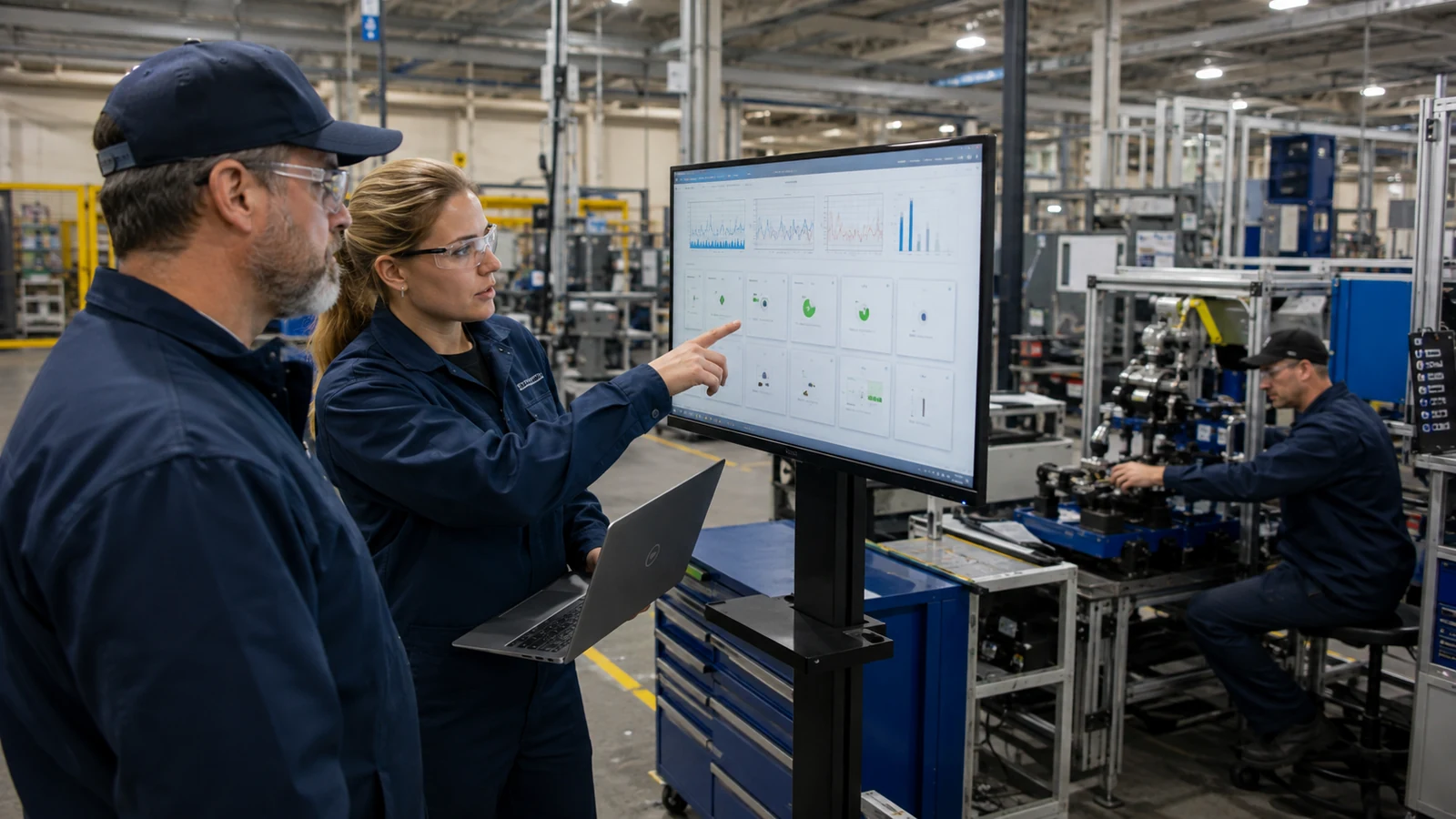
The first manufacturing process to automate should combine a measurable business loss, stable work, technical feasibility, safe integration and useful learning. Repetition alone is not enough. A repetitive process with unstable material, frequent engineering changes or no reliable baseline can become an expensive automation problem.
A practical selection method uses two stages. Hard gates remove opportunities that are unsafe, poorly defined or incompatible with the product. A weighted score then compares the remaining candidates by business value and readiness. This prevents a high labor-cost estimate from hiding weak technical evidence.
What makes a process a good first automation candidate
A good first candidate has repeatable work, a stable cycle, measurable demand, known input variation, a controllable interface and a clear operating owner. It should also solve a real constraint, quality loss, ergonomic exposure or labor-availability problem.
Start with the customer and production requirement. Record demand by product family, required takt, current good output, scrap, rework, staffing and schedule losses. A project based on theoretical machine speed may improve a non-constraint while the factory continues to miss orders elsewhere.
Stability matters because automation repeats the process it receives. If components arrive in random orientation, drawings change weekly or operators rely on undocumented judgment, the cell will need sensing, fixturing and exception logic. That may still be viable, but it is no longer a simple first project.
Technical feasibility includes more than robot reach. The team must understand part variation, tolerances, presentation, cycle-time distribution, upstream and downstream behavior, utilities, controls, data exchange, maintenance access and recovery after a fault. The hardest valid product should be tested, not the most convenient sample.
Safety and ergonomics are separate criteria. Removing heavy lifts, sharp contact or hazardous exposure can create value that a labor-only payback misses. However, labeling equipment as a cobot does not make the application safe. The tool, part, speed, force, layout and human interaction determine risk.
The first project should also create reusable capability. A cell that teaches the plant how to write robot standards, validate safety, manage spares and train technicians may support later projects. That learning value should be stated and bounded, not used to excuse a weak use case.
Should a factory improve the process before automating it
A factory should simplify and stabilize a process before automation when the main losses come from layout, excessive handling, missing standard work, unreliable materials or poor scheduling. Automating waste can make it faster and harder to change.
Observe the work before writing a specification. Count operator touches, walking distance, queues, adjustments, searches, inspections and restarts. Separate value-producing work from movement and waiting. Ask which problems disappear if the workplace is reorganized, containers are standardized or upstream quality improves.
A NIST MEP case titled Half as Many Touches describes a layout and continuous-improvement effort that reduced handling touches from 30 to 15. The example does not prove that lean improvement always replaces automation. It shows why the counterfactual must include a simpler process, not only the current state.
Improvement and automation can also be sequential. A team may first standardize part presentation, then automate the remaining repeatable motion. This reduces sensing complexity and makes cycle time more predictable. The baseline should be updated after process improvement so the automation business case does not claim benefits already achieved.
How should automation opportunities be scored
Automation opportunities should be scored on business value and technical readiness separately. A project should pass safety, product and process gates before weighted scoring begins.
Recommended hard gates include a defined product family, feasible safety concept, available production space, stable essential inputs, an owner for the process and a credible method to meet quality requirements. A failed gate does not permanently reject the project. It creates prerequisite work.
| Criterion | Example weight | Evidence required | Warning sign |
|---|---|---|---|
| Safety and ergonomic improvement | 15% | Risk assessment and exposure data | Benefit described only as “removing people” |
| Throughput or constraint impact | 15% | Good units, queues and bottleneck evidence | Local speed with no system effect |
| Labor exposure and availability | 10% | Hours by task and shift, vacancy or overtime data | Full headcount counted without redeployment plan |
| Quality and traceability | 10% | Scrap, rework and defect mechanism | Automation cannot control the defect source |
| Process stability | 10% | Cycle distribution and standard work | High unexplained variation |
| Technical feasibility | 15% | Trials with hardest parts | Proposal based on a video or easy sample |
| Product and demand stability | 10% | Forecast and engineering-change history | Short product life or uncertain volume |
| Integration complexity | 5% | Interface and layout review | Undocumented legacy control |
| Financial case | 5% | Installed cost and downside scenario | Robot price used as total cost |
| Learning and reuse | 5% | Named standards or assets to reuse | Vague strategic benefit |
Score each item from one to five using written anchors. A five for feasibility might require a successful timed trial, defined gripper and verified interface. A three may mean feasible with engineering work. A one means a major unknown. Confidence should be recorded beside the score. An attractive score supported by assumptions should not outrank a slightly lower score supported by plant data.
Keep disqualifying gates outside the weighted average. A safety risk cannot be compensated by cheap hardware. A cycle that fails the takt cannot be made acceptable by high learning value. This discipline is especially important when a preferred supplier has already presented a solution.
Which manufacturing processes are commonly automated first
Machine tending, packaging, palletizing, inspection, welding, dispensing and structured material handling are common first projects because their work can be repetitive and measurable. Each still has conditions that determine fit.
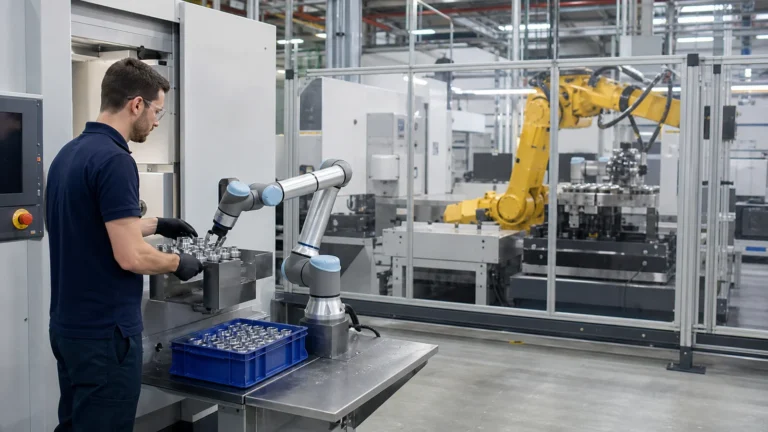
Machine tending works well when parts can be presented consistently, machine doors and controls can be integrated, and automated time fits the machining cycle. It becomes difficult when fixtures require judgment, chips interfere with handling or product changes demand many end effectors.
Packaging and palletizing have visible volume and ergonomic exposure. They are strong candidates when case dimensions, labels, pallet patterns and rates are known. They become complex with unstable cartons, frequent unplanned SKUs, manual rework and downstream congestion. A detailed guide to robotic palletizing costs and throughput should be used when this use case reaches the shortlist.
Automated inspection can improve consistency and data capture. It is suitable when defects are visually or dimensionally distinguishable and representative samples exist. It is a poor first AI project when defect labels are ambiguous or lighting and product appearance change without control.
Welding and dispensing can improve repeatability, but fixturing and joint access determine success. A robot cannot compensate for large incoming dimensional variation without additional sensing and process control.
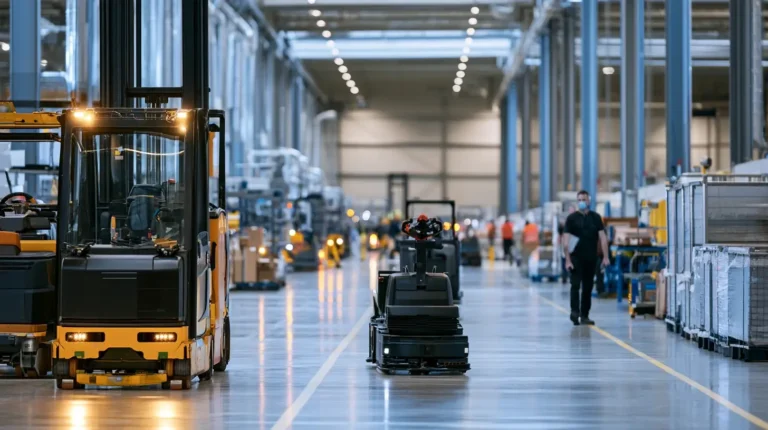
Material handling can reduce travel and waiting. The team must model routes, traffic, interfaces and exceptions. Automating transport between two unstable processes can simply move queues faster.
How should ROI safety and workforce impact be compared
ROI should not be the only selection criterion because safety exposure, quality risk and integration learning have real value. Those benefits still need evidence and should not be converted into invented cash savings.
The financial case should start with total installed cost, not the robot or machine price. Include tooling, fixtures, guarding, controls, software, utilities, integration, commissioning, training, production interruption, spares and recurring support. InduVista’s guide to calculating production automation ROI provides the full calculation.
Labor benefit should use task hours that the future process actually removes. If an operator spends 30 percent of a shift loading a machine and the remaining work stays, do not count a full position unless the future staffing and redeployment plan supports it. Include supervision, replenishment, changeover, quality checks and recovery work that remains.
Safety can act as a gate or an additional benefit. Use the plant’s risk method and relevant regulations. The NIOSH ergonomics program emphasizes identifying and controlling risk factors rather than relying on a single job label. A lower-risk design may deserve priority even when simple payback is longer.
Workforce impact should be discussed before procurement. Operators often hold important exception knowledge. Involving them in observation, trials and acceptance criteria improves the specification. Training must cover normal operation, fault recovery, changeover and the boundaries of authorized maintenance.
What evidence comes from early automation projects
Case studies show what can happen under defined conditions, but they do not establish a universal payback.
A NIST MEP case on AMG Industries reported a USD 50,000 UR10e project. Output increased from 200 to 276 pieces per hour, a 38 percent change, and the forecast payback moved from 11.5 to 6.5 months. The result belongs to that application, volume and cost structure.
“It allowed us to try the technology without risk and without the upfront investment.”
Jes Salmons, Director of Engineering at AMG Industries, made this statement in the NIST MEP case. It highlights the value of a lower-risk trial structure. It does not mean that every rental, demonstration or grant-funded project is economically superior to purchase.
Another NIST MEP case from Area 419 described one staffed shift while automation used machine capacity during the remaining 16 hours. The case illustrates a specific operating model: unattended hours create value only when material, quality, alarms and recovery are designed for them.
What should the first automation pilot include
A first pilot needs a baseline, the hardest product test, measurable acceptance criteria, a safety plan and an owner. It should prove the operating process, not only that a robot can move a sample.
| Pilot measure | Current baseline | Acceptance definition | Evidence |
|---|---|---|---|
| Good output | Units per hour by product | Sustained rate for defined run | Timestamped production count |
| Quality | Scrap and rework by defect | Maximum defect rate and no unapproved escapes | Inspection record |
| Availability | Defined scheduled run | Minimum availability with excluded events listed | Automatic state log |
| Changeover | Median and range | Maximum time for specified product change | Observed timed trial |
| Recovery | Time and skill after common faults | Safe restoration within defined method | Fault-injection test |
| Safety | Current risk assessment | Validated future risk controls | Signed assessment and validation |
- Freeze the product and process scope for the test.
- Record current cycle-time distribution, good output, scrap, labor and stops.
- Define the required takt and peak rate separately.
- Test the most difficult valid parts, containers and environmental conditions.
- Complete risk assessment and safety validation before production use.
- Define upstream presentation and downstream removal.
- Specify changeover time and who performs it.
- Test planned stops, jams, sensor failure and restart.
- Measure quality after normal operation and after recovery.
- Define availability and data-collection rules.
- Train operators and maintenance technicians by role.
- Compare the result with the updated, improved manual baseline.
Supplier selection should follow testable requirements. InduVista’s industrial technology supplier evaluation checklist explains how to connect evidence, scoring and contractual acceptance.
How should a factory govern the automation portfolio
An automation portfolio should use the same definitions, gates and evidence across projects. This allows management to compare opportunities without forcing every process into the same technical solution.
Create a small cross-functional review involving operations, engineering, maintenance, safety, quality, IT or OT and finance. The group should own the scoring rules, confirm baselines and challenge assumptions. It should not replace the process owner. Its role is to make evidence comparable and stop recurring mistakes.
Record each opportunity in a common register. Include the problem, baseline, product scope, proposed concept, hard-gate status, score, confidence, installed-cost range, owner and next evidence required. A project with low confidence may receive a small trial budget instead of full approval. A project with strong evidence and a failed safety gate returns for redesign.
Review the portfolio after pilots. Compare forecast and actual cycle time, availability, labor realization, ramp-up and support effort. Update the scoring anchors when several projects reveal the same bias. For example, if integrator commissioning repeatedly takes longer than planned, future estimates should reflect that history.
The portfolio should also show dependencies. A common robot standard, vision library, safety architecture or data connector can lower the cost of later projects. Count this benefit only when the asset is documented, governed and actually reused. A collection of different cells with different controls may increase maintenance complexity even when every project has a positive standalone payback.
Practical checklist
Use this checklist to select and prepare a first automation project.
☐ The opportunity addresses a measured constraint, quality loss, ergonomic exposure, labor shortage or recurring operating cost.
☐ The product family, process boundary and accountable process owner are defined.
☐ The current process is stable enough to describe, repeat and measure under normal variation.
☐ The team has simplified layout, handling and standard work before deciding which remaining activity to automate.
☐ The baseline includes cycle-time distribution, good output, scrap, rework, labor, stops and changeovers by relevant product or shift.
☐ Safety, product definition, available space, stable inputs, quality method and process ownership pass the hard gates.
☐ Business value and technical readiness are scored separately so a high saving cannot hide weak feasibility.
☐ The feasibility test uses the hardest valid parts, containers, tolerances and environmental conditions.
☐ Upstream presentation, downstream removal, queues, interfaces and exception handling are included in the concept.
☐ Total installed cost includes tooling, fixtures, guarding, controls, integration, utilities, training, downtime, spares and support.
☐ The pilot defines acceptance for output, quality, availability, changeover, safety and recovery from common faults.
☐ Operators and maintenance technicians can run, change over and restore the process without extraordinary project-team support.
☐ Results are compared with the updated improved-manual baseline, not the original process before easy improvements.
☐ The project creates documented standards, skills or reusable architecture that can support later automation projects.
Frequently asked questions
Should the bottleneck always be automated first
No. The bottleneck deserves priority, but automation is only one option. Setup reduction, maintenance, staffing, flow or product design may recover capacity faster and with less risk.
Is a cobot the safest first automation project
Not automatically. Safety depends on the complete application, including tool, part, speed, force and interaction. Use the comparison of a cobot and industrial robot after defining the use case.
How many shifts are needed for automation to pay off
There is no fixed number. More operating hours can improve asset utilization, but demand, availability, staffing, maintenance and installed cost determine the result.
Should a first project eliminate a job
Job elimination should not be the default objective. A strong first project may remove hazardous or repetitive task hours, support scarce labor, improve quality or extend productive time while employees move to other work.
Sources
- Automation 101 How to Plan for Successful Implementation, NIST MEP National Network, 2025.
- Robotics and Manufacturing Automation, NIST MEP.
- AMG Industries Increased Productivity and Cost Savings with Collaborative Robots, NIST MEP, 2024.
- Automation Results in Increased Investment and Staffing, NIST MEP, 2025.
- Half as Many Touches, NIST MEP, 2022.
- Elements of Ergonomics Programs, NIOSH.


[…] Test a downside case. Reduce adoption, performance and volume. Extend ramp-up. Increase support cost. If a small change destroys the return, management needs a staged commitment or better evidence. For a fuller capital review, use a practical production automation ROI guide; for lifecycle comparison, use which manufacturing processes to automate first. […]
[…] Test a downside case. Reduce adoption, performance and volume. Extend ramp-up. Increase support cost. If a small change destroys the return, management needs a staged commitment or better evidence. For a fuller capital review, use cobot and industrial robot selection criteria; for lifecycle comparison, use which manufacturing processes to automate first. […]
[…] return, management needs a staged commitment or better evidence. For a fuller capital review, use which manufacturing processes to automate first; for lifecycle comparison, use a practical production automation ROI […]