



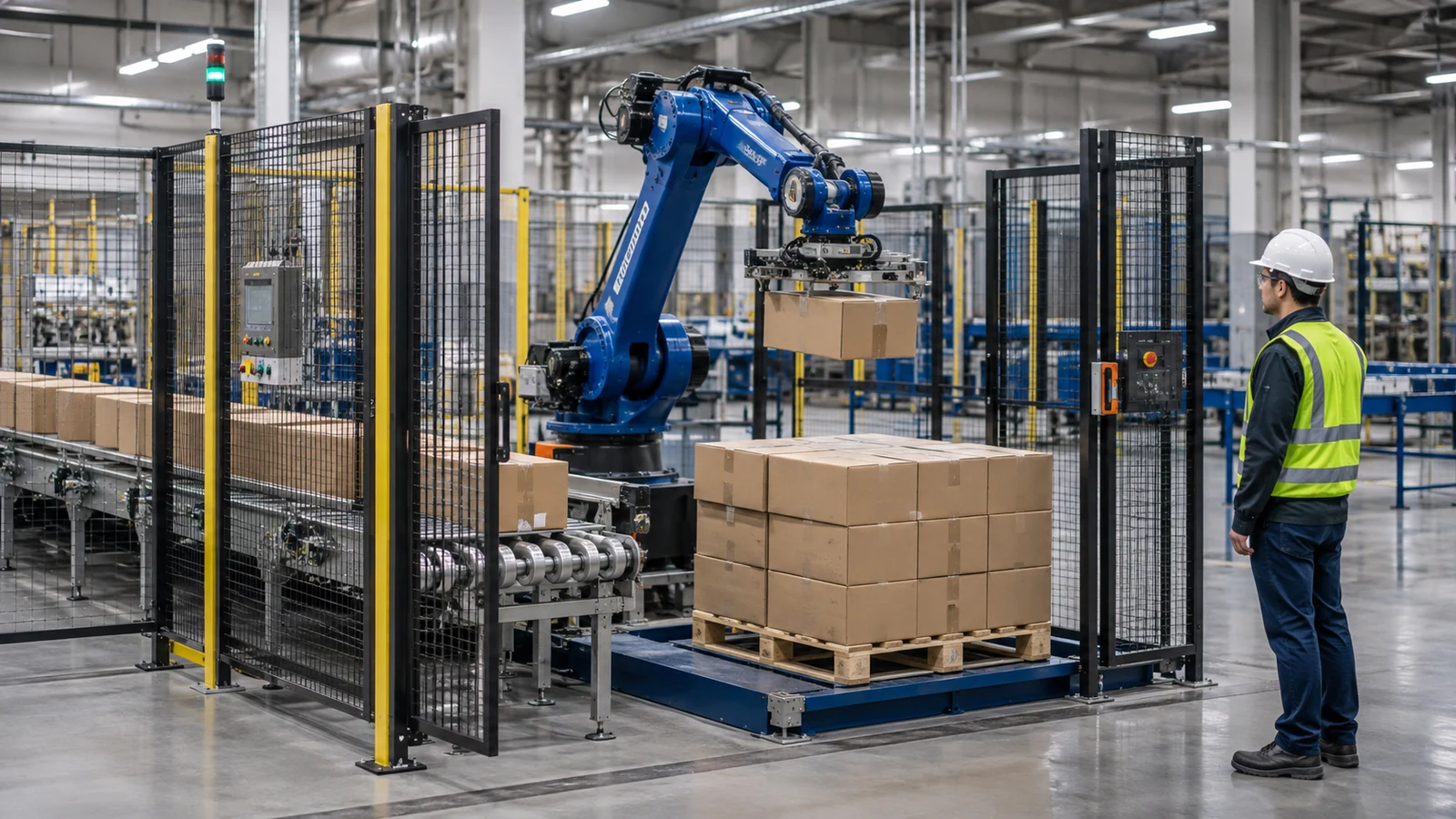
The cost of robotic palletizing must be calculated for a complete cell, not a robot arm. A working system can include the robot, end effector, product conveyor, pallet handling, slip sheets, controls, software, safety equipment, integration, commissioning and training. Throughput must also be measured for the actual product mix and pallet change process.
Public price ranges often omit these boundaries. A credible budget starts with a defined specification and an acceptance test. A credible ROI then uses good pallets per hour, actual operating time and the labor and support work that remain after automation.
What is included in a robotic palletizing cell
A complete robotic palletizing cell includes every component and service needed to receive a valid case, build the specified pallet safely and release it to the next process. The exact boundary should be written into the request for quotation.
The robot arm provides reach, payload and motion. The end effector handles cases, bags, pails or trays. Its design affects payload, cycle time, air or electrical demand and the ability to manage damaged or variable packaging. A multi-pick gripper can lift several products per robot cycle, but it requires a product accumulation and spacing strategy.
Product infeed establishes orientation and timing. It may need sensors, metering belts, accumulation and rejection. Pallet supply may be manual or automated. A system can also require a pallet dispenser, slip-sheet handling, corner boards, labels, wrapping or transfer to a warehouse conveyor.
Controls coordinate all equipment. The scope can include a PLC, robot controller, HMI, recipe management, production reporting and connection to line controls. The design must define what happens when upstream stops, a pallet is unavailable, a label fails or an operator enters the area.
Safety is part of the cell, not an optional accessory. Guarding, scanners, light curtains, interlocks, emergency stops and safe control functions depend on risk assessment. A collaborative robot may reduce some guarding needs in a specific validated application, but the payload, gripper and moving case can still create hazards.
Integration includes mechanical design, electrical work, programming, trials, factory acceptance testing, installation, site acceptance testing and production ramp-up. A quotation should identify utilities, floor work, permits, transport, taxes, production access and the party responsible for interfaces.
How much does robotic palletizing cost
There is no neutral universal price for robotic palletizing because the scope varies widely. The robot can be a minority of installed cost when the project requires complex handling, conveyors, safety, line changes or building work.
| Cost component | Main specification driver | Evidence required in a quote | Often excluded |
|---|---|---|---|
| Robot and controller | Payload, reach, duty and environment | Model, options and rated limits | Special coatings or environmental rating |
| End effector | Case material, mass, dimensions and multi-pick | Trials with worst valid packaging | Spare cups, pads or tool change parts |
| Product infeed | Rate, accumulation and orientation | Layout and control sequence | Upstream modifications |
| Pallet handling | Pallet types, supply and discharge | Capacity and recovery method | Forklift or conveyor interface |
| Safety system | Access, speed, payload and application risk | Risk assessment and validation plan | Building or traffic changes |
| Controls and software | Recipes, HMI, reporting and interfaces | Functional specification | MES or line-controller changes |
| Integration | Number of SKUs and abnormal scenarios | FAT, SAT and ramp-up scope | Travel, overtime and production interruption |
| Training and spares | Roles, shifts and response expectations | Training plan and spare-parts list | Refresher training and obsolescence |
| Operating cost | Energy, air, consumables and maintenance | Annual estimate and assumptions | Internal technician time |
A buyer should request a base price and separately priced options. The scope should say whether the supplier handles pallets, slip sheets, labels and wrapping. It should state whether civil work, electrical distribution, network changes and guarding outside the cell are included. Currency, taxes, shipping, warranty and support response also need definition.
Do not compare two bids until their boundaries match. One integrator may quote a robot and basic fence. Another may include conveyors, pallet dispenser, commissioning and production support. The lower headline price may produce the higher installed cost.
The business case should also include the cost of production interruption. Installation may require a weekend, planned shutdown or staged bypass. Ramp-up can reduce output before the new process becomes stable. These costs are real even when they do not appear as a supplier invoice.
How should palletizing throughput be calculated
Palletizing throughput should be calculated in good cases, layers or pallets per hour for the real product mix. Robot cycles per hour are not directly comparable with cases per hour because one cycle can handle one or several cases.
ABB lists the IRB 460 with a 2.4 metre reach and 110 kilogram payload. Published cycle figures vary with load. Those parameters describe the robot under defined motion conditions. They do not include product accumulation, pallet change, slip sheets, faults or downstream waiting.
Begin with the product requirement. For each SKU, record case dimensions, mass, centre of gravity, packaging strength, permitted orientation, pallet pattern, layers and cases per pallet. Then define the required average rate, peak rate and duration of peaks.
Cycle time includes approach, pick, transfer, place and return. Add gripper actuation and verification. If the robot picks two cases at once, cases per cycle increase, but the infeed must present both cases correctly. The slowest component controls the sustained rate.
Pallet change is often hidden. If a cell builds a pallet in ten minutes and needs 30 seconds to remove it and present the next pallet, the ideal output loses almost five percent before other stops. Dual pallet stations or automated transfer can reduce this loss but add cost and space.
| Throughput input | SKU A | SKU B | SKU C |
|---|---|---|---|
| Cases per robot pick | 1 | 2 | 1 |
| Robot picks per minute | 8 | 6 | 7 |
| Ideal cases per minute | 8 | 12 | 7 |
| Cases per pallet | 80 | 96 | 70 |
| Pallet change allowance | 0.5 min | 0.7 min | 0.5 min |
| Availability assumption | 90% | 88% | 90% |
| Product mix share | 50% | 30% | 20% |
These values are illustrative, not benchmark data. A useful calculator converts each SKU into sustained good cases per hour, includes pallet-change and availability allowances, and weights the result by mix. It should also test the hardest SKU separately. An average can hide a product that misses the line rate.
A case study from Orkla Foods described a system handling 48 containers per pick, building a pallet in about ten minutes and reaching a stated 8,500 products per hour. The example shows how multi-pick changes the relationship between robot cycles and product count. It does not establish a general rate for carton palletizing.
Should a manufacturer choose a cobot or an industrial robot
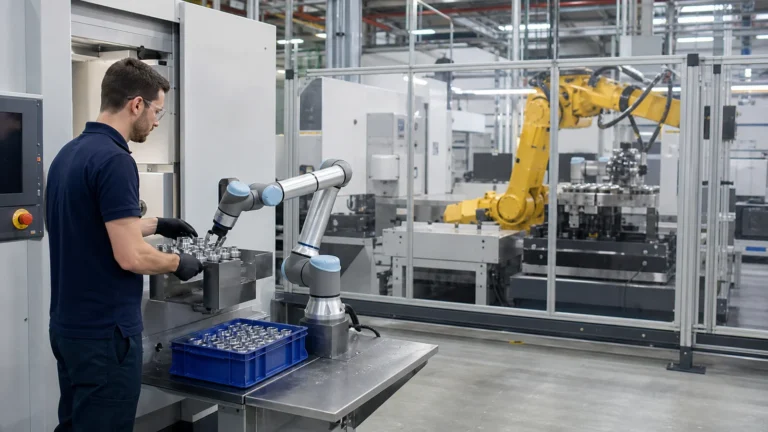
A cobot can suit lower payload, moderate speed and flexible deployment. An industrial robot is often better for high throughput, long reach or heavy loads. The correct choice depends on the complete cell and risk assessment, not the label attached to the arm.
Collaborative operation may allow people to work near the system under validated limits. It can also require speed and force restrictions that reduce throughput. A sharp tool, unstable package or heavy payload can make collaborative contact unacceptable. Conversely, an industrial robot inside a well-designed guarded cell may deliver higher output with clear separation.
Compare payload including the gripper, reach to every pallet position, axis speed, duty, environmental rating and maintenance support. Also compare footprint after safety equipment. A small arm with a wide scanner field may use more floor area than expected.
InduVista’s full comparison of a cobot versus an industrial robot explains the selection criteria. For palletizing, test both options against the same SKU mix, layout, rate and acceptance conditions.
How can a manufacturer calculate robotic palletizing ROI
Robotic palletizing ROI should include installed cost, remaining labor, availability, maintenance, consumables, changeovers, production interruption and the value of ergonomic risk reduction. The model should use three scenarios rather than one forecast.
Start with productive hours. Scheduled hours are reduced by planned cleaning, changeovers and breaks that still stop the cell. Apply a realistic availability based on the proposed design and support plan. Multiply sustained rate by productive time and compare it with demand. Output above demand does not create value unless it removes a constraint or supports growth.
Labor benefit must reflect tasks that disappear. Operators may still replenish pallets and slip sheets, clear damaged cartons, perform changeovers, inspect loads and respond to faults. If one employee can supervise several stable cells, describe how the staffing pattern works across shifts. Do not count a full position when the remaining tasks prevent redeployment.
Add maintenance labor, preventive parts, gripper consumables, energy and software support. Include expected downtime cost if the automated cell becomes a single point of failure. A bypass, manual fallback or spare-part strategy can reduce this risk but has a cost.
Ergonomic benefit deserves explicit treatment. The Revised NIOSH Lifting Equation considers load, reach, asymmetry, frequency, duration and grip. A plant can use its established ergonomic method to compare current exposure with the future task. Do not convert risk reduction into cash without an approved method; it can remain a separately reported decision factor.
Use a conservative scenario with lower availability, no growth, higher ramp-up cost and partial labor realization. The expected scenario should use the best supported assumptions. An upside case may include approved demand growth. The project should remain acceptable under a plausible downside or have a clear reason why strategic or safety value justifies the risk.
InduVista’s guide to production automation ROI provides a broader model. Palletizing adds specific drivers: cases per pick, pallet exchange, packaging variation and manual fallback.
What do published palletizing cases show
Published cases show that product and cell design can change rate and labor requirements, but they are not price or payback benchmarks.
A Vention and Universal Robots case described seven UR20 palletizing cells, about 1,200 SKUs, cases up to 20 kilograms and a rate change from 5.5 to 8.2 cases per minute. That is a 49 percent increase for the reported application. Buyers should review the product mix and cell boundary before comparing it with their own line.
A FANUC America case from St James Winery described the palletizing of 20 pallets and 1,700 packages per day and reported a payback of less than one year after one shift. The detailed CAPEX and full calculation were not published, so the result cannot be audited as a general benchmark.
“Now margins are better and labor per case is about thirty five to forty percent less than it was.”
Andrew Meggitt, Chief Production Officer and Executive Winemaker at St James Winery, made this statement in the FANUC America case study. It is a company-specific outcome and should be presented with that context.
What should be included in a palletizing RFQ and acceptance test
A palletizing RFQ should define products, packaging, mass, orientation, pallet patterns, rates, environment, safety, interfaces and the hardest acceptance scenario. The goal is to make supplier proposals comparable and the final result enforceable.
Include the complete SKU list or a governed product-family method. State allowable carton damage, label visibility, pallet overhang, stack stability and pattern rules. Define pallet quality, slip sheets and consumables. Provide the upstream conveyor elevation, available accumulation, downstream handling and floor constraints.
The functional specification should describe normal operation and abnormal recovery. Ask how the system handles a missing case, collapsed carton, lost vacuum, pallet fault, emergency stop and network interruption. Define whether recovery must preserve the partial pallet pattern.
Factory acceptance testing should use representative equipment and the most difficult valid products. Site acceptance testing should demonstrate the complete installed cell. Acceptance metrics can include sustained good cases per minute, completed pallets, changeover time, availability during a defined run, fault recovery and load quality.
Safety validation must cover the installed application. OSHA’s robotics standards resource points users to relevant consensus standards and requirements. The project team should use qualified safety expertise and applicable local law.
Supplier evaluation should connect every score to evidence. InduVista’s guide to selecting an industrial technology supplier provides qualification gates, references and contractual controls.
Robotic palletizing decision checklist
- Define every valid SKU, package and pallet pattern.
- Measure average and peak line rate by product family.
- Calculate sustained cases and pallets per hour, not robot cycles alone.
- Include pallet exchange, slip sheets, labels and downstream handling.
- Test the hardest package and the most demanding reach position.
- Compare cobot and industrial robot under the same safety and rate assumptions.
- Price the complete installed scope and production interruption.
- Define remaining operator, replenishment and recovery tasks.
- Include maintenance, consumables, support and spare parts in TCO.
- Run conservative, expected and upside financial scenarios.
- Write FAT and SAT conditions into the purchase agreement.
- Validate the complete application and train each role.
Frequently asked questions
How many cases per minute can a palletizing robot handle
There is no single rate. Throughput depends on payload, travel, gripper, cases per pick, product presentation, pallet pattern, pallet change and availability. Calculate it for each SKU and the weighted mix.
Can a cobot palletize 20 kilogram cases
Some cobot systems can handle cases in this range, subject to arm payload, gripper mass, reach, motion and safety validation. A rated payload alone does not confirm cycle time or application safety.
What costs are usually excluded from robot prices
Common exclusions include gripper engineering, conveyors, pallet handling, guarding, civil work, electrical distribution, line integration, commissioning travel, production interruption, training and recurring support.
How much floor space does robotic palletizing need
Footprint depends on robot reach, pallet positions, guarding or scanner fields, infeed, pallet exchange and maintenance access. A scaled layout and risk assessment are required.
Sources
- ABB IRB 460, ABB Robotics.
- Palletizing for the Palate, ABB case study.
- Vention Center of Excellence Support Case Study, Universal Robots, 2024.
- St James Winery Boosts Efficiency, FANUC America.
- Revised NIOSH Lifting Equation, NIOSH.
- Robotics Standards, OSHA.

[…] cartons, frequent unplanned SKUs, manual rework and downstream congestion. A detailed guide to robotic palletizing costs and throughput should be used when this use case reaches the […]